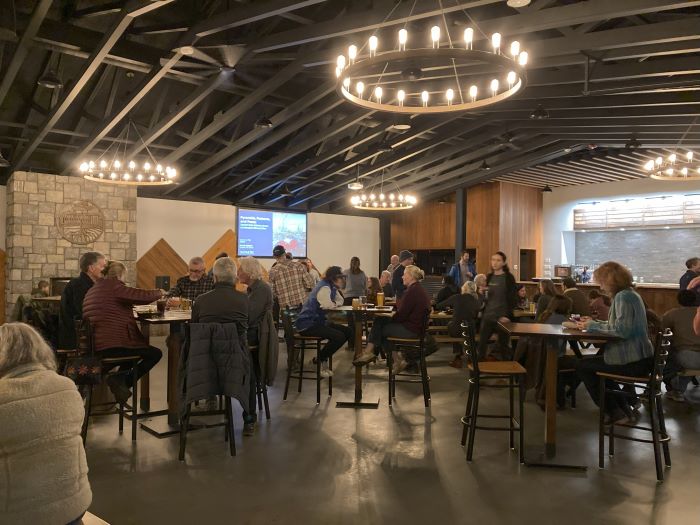
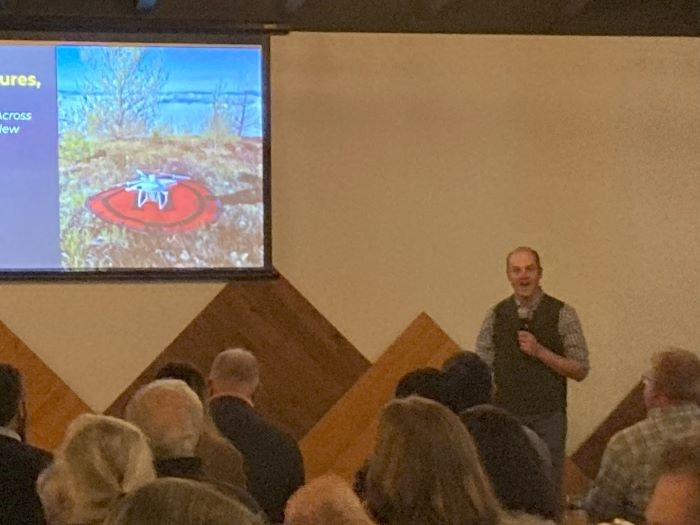
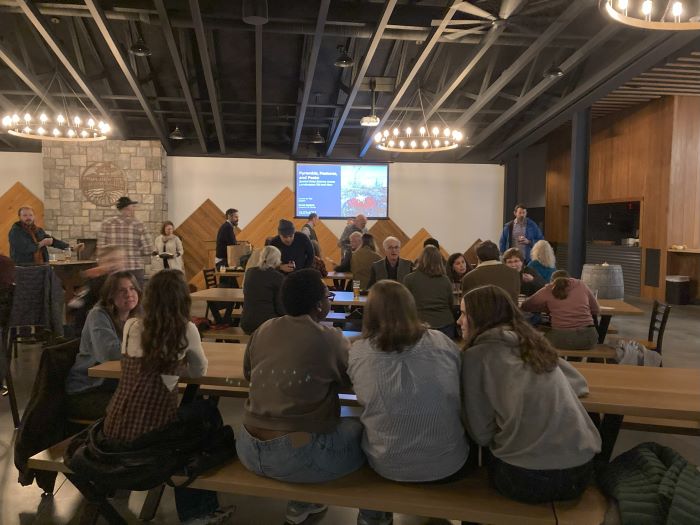
Science On Tap Saratoga, where curiosity meets community in a lively setting! It’s not just a talk; it’s an an exciting journey into the world of science! Questions are welcome, and conversations flow as freely as the drinks.
Hosted at Common Roots Brewing Company’s Bierhall in South Glens Falls, Science On Tap Saratoga is a collaboration between Skidmore’s Environmental Studies and Sciences Program and Sustainable Saratoga. So, come sip, savor, and soak up some science—you never know what fascinating facts you might take home.
Come early and enjoy a meal at Common Roots Brewing Company, and then stroll over to the Bierhall. Doors open at 6pm. Talks start at 7pm.
2026 Talks
January 28, 2026 — Daniel Peterson – Skidmore College
Fake News on Social Media: Exploring Age Effects
Today, most Americans get their news, at least in part, via social media. Unfortunately, the way news stories are propagated and shared on such sites can amplify fake news stories. Though the factors underlying who falls prey to believing such stories and why is well examined with younger adults, there’s comparatively much less research looking into older adults. In this talk, I’ll detail two studies (and introduce an ongoing third) that looks at the factors that predict when older adults endorse fake news stories and how those effects differ from the more commonly studied younger adult population.
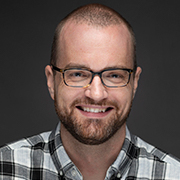
Daniel Peterson is a cognitive psychologist specializing in human memory. He completed both his undergraduate and graduate work at the University of North Carolina at Chapel Hill where he examined the theoretical underpinnings of memory retrieval. Today, he is an Associate Professor of Psychology at Skidmore College where he looks at more applied memory questions including effective study strategies and eyewitness memory.

March 18, 2026 — Kelsey Jensen – Skidmore College/The Soil inventory Project
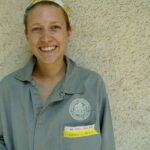 Measuring What Matters: Turning Soil Data into Climate Solutions
February 25, 2026 — Kim Frederick – Skidmore College
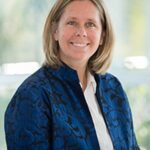
Turning All Citizens into Scientists using Paper and Cell Phones
For too long, scientific information has only been accessible to scientists who have access to lab facilities. More recently, the World Health Organization established the REASSURED standard which calls on the science community to develop testing technology that is Real-time, Easy, Affordable, Sensitive, Specific, User-friendly, Rapid and robust, Equipment-free and Deliverable. Our lab at Skidmore College develops paper-based testing devices where the science measurement can be done with a cell phone camera. In recent years we have developed microfluidic paper analytical devices (µPADs) for measuring contamination of drinking water by hydrofracking wells, ensuring proper dosage for antibiotic tablets and developing a urine-based diagnostic for malaria. In this discussion we will talk about how this technology works, what kinds of problems we have tackled and what problems of local interest might be important for us to look at. Come and join the conversation!
April 29, 2026 — Jesse Ernst – University at Albany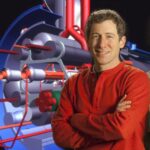
Could that Star Already be Dead? Why Relativity Says You Can’t Ask.
The theory of Special Relativity is now over 120 years old. Its conclusions about how time slows down in GPS satellites and about how many particles reach Earth’s surface have been confirmed countless times. But what relativity says about the nature of space and time is still so deeply counterintuitive that our lack of intuition can make us wrong even about things that seem obvious. In this talk, I’ll first introduce the basic ideas of Special Relativity. I’ll then discuss the often repeated story that some of the starlight we see might be from long-dead stars, and explain why that story is asking a question that doesn’t actually have an answer.
Jesse Ernst is an Associate Professor and the Chair of the Department of Physics at U Albany. He conducts research in the area of elementary particle physics. Jesse and his family reside in Saratoga Springs.
May 27, 2026 — Margaux Hein – MER Research and Consulting
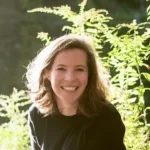
Restoring Coral Reefs: Science, Hope, and Climate Reality
Coral reefs are often called the rainforests of the sea, yet many are disappearing faster than we ever imagined. Rising ocean temperatures, pollution, and overfishing are pushing reefs toward a tipping point, but all is not lost. Around the world, scientists, communities, and practitioners are working to give reefs a fighting chance.
In this talk, I’ll introduce what coral reef restoration really means (hint: it’s more than just planting coral), and explore the different strategies being used from the Caribbean to the Pacific. I’ll show why there’s no one-size-fits-all solution: what works in one place may fail in another, depending on local threats, people, and ecosystems. From coral nurseries and reef gardening to working with nature and supporting reef resilience, restoration is as much about social and cultural context as it is about science.
Finally, we’ll take an honest look at the future of coral reefs in a warming world. What can restoration realistically achieve? Where does it help most, and where does it fall short? And how can hope, grounded in science and climate reality, guide the next chapter of reef conservation?
Whether you love the ocean, worry about climate change, or simply enjoy a good story over a pint, this talk will leave you with a clearer picture of what’s possible and what’s at stake for the world’s coral reefs.
Dr. Margaux Hein is a marine biologist, Founder and Lead Consultant of MER Research and Consulting.
Originally from the Principality of Monaco, she obtained a Bachelor Degree in Environmental Science at the
University of Queensland and her Masters and Doctorate at James Cook University in Australia. Her expertise and passion revolve around coral reefs and finding ways to protect and conserve them in the face of rising environmental and climatic challenges. Her research focuses on improving the effectiveness of coral reef restoration efforts across socio-economic and ecological scales.
With projects around the world since 2012, she is currently acting as an official consultant with the International Coral Reef Initiative, the Reef Resilience Network, The Nature Conservancy, and Fondation Prince Albert II de Monaco.


See our Events Calendar for more opportunities to engage and learn.