by Johanna Garrison
There is no set prescription for combatting hopelessness or gloom, but personally, I have found, time and again, that getting my hands dirty and observing new beginnings is one of the simplest, purest life-affirming acts there is.
 Sowing My Way to Sanity
Like many during Covid lockdown, I felt drawn to seed and soil. In her book, What We Sow: On the Personal, Ecological, and Cultural Significance of Seeds, Jennifer Jewell writes, “A seed is the dormant dream of a new life.” Jewell continues, “The notion of it, a seed, and the very act of it, to seed, permeate our collective cultural fabric and imagination. Seeds are the flesh of life and one of the smallest visible units of its meaning, they are the future of that flesh and meaning, and they hold the metaphoric bounty of it all wrapped up in the enormous diversity of their relatively tiny forms.”
Every time I pick up an acorn, I think, how? How does this tiny hooded nugget become a centuries-old behemoth, not to mention on a national level, play larval host plant to nearly 1,000 species of moth and butterfly, in turn feeding hundreds of birds and other wildlife? Growing our own, creating beauty, nourishing both mind and body, all while investing in the health of our children and community– that is the seed of good fortune.
 Sow Those Blues Away
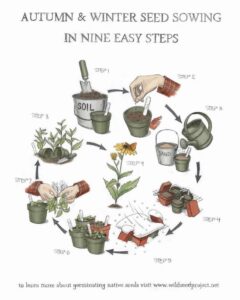
Winter sowing was a term I first heard five years ago during Covid. I had no idea you could sow seeds in January and store them outdoors all winter! Up to that point, I’d been placing jars or ziplocs of native seeds saved from my garden in the fridge for sixty days and then planting in spring. Many seeds require stratification, a period of cold, moist conditions that mimics winter so the seeds will break dormancy and germinate. Then I listened to a Joe Gardener podcast with Heather McCargo of Wild Seed Project. “Let nature do the work!” Heather urged. A few clean pots, soil, sand, seeds and a screen under my deck all winter? I could do that. Plus, it was practically like growing a garden for free. Plants for myself, plants to share… what’s not to love?
What Native Plants Teach Us
Most native seeds don’t need special care or fertilizer to grow because they are adapted to our native soils and faithfully temper the conditions of our inconstant climate. Additionally, propagating native seeds helps preserve genetic diversity. “The biggest problem I have with cultivars is that they’re all cloned,” McCargo says. “So we’re mass-producing a really narrowed gene pool.” A cultivar, or nativar, is a plant propagated by humans to clone preferred traits like color, size, yield, petal shape, or disease resistance. Considerable research has been dedicated to producing cultivars; that’s not to say that certain cultivars aren’t worthy of our garden space, but without seed diversity, plants frequently fall prey to disease, predatory insects, and changing climate conditions. Sowing seeds of straight (native) plant species ensures genetic biodiversity, resilience, and the health of our planet.
 Come Join Us and Learn How… It’s Sow Easy!
Sustainable Saratoga and SoBro Conservancy are co-hosting a free winter sowing workshop on Thursday, January 29 from 5-7pm at the Skidmore Center for Integrated Sciences. Drop by anytime between 5 and 6:30pm. Soil, seeds, and recycled pots will be provided, but please feel free to bring your own recycled plastic milk jugs or containers/pots. Volunteers will be on hand to instruct and answer questions. Within a few quick steps, you’ll have your own potential garden at the ready!
~~~~~~~~~~~~~~~~~~~~~~~~~~~~~~~~~~~~~~~~~~~~~~~~~~~~~~~~~~~~~~~~~~~~~~~~
Resources:
The Easiest Way to Start and Grow Seeds in Winter: No Special Equipment Required
https://joegardener.com/podcast/easiest-way-to-start-and-grow-native-seeds-winter/
Wild Seed Project – Autumn and Winter Sowing in Six Easy Steps
https://wildseedproject.net/blog/ideal-time-for-sowing-native-seeds
Get Dirty. It’s Surprisingly Good for Your Health
https://www.nytimes.com/2024/04/17/well/live/dirt-health-benefits.html
Jewell, Jennifer. What We Sow: On the Personal, Ecological, and Cultural Significance of Seeds. Timber Press, 2023.