by Dianna Goodwin
At the beginning of the summer, we launched our Hellstrip Heroes project, challenging people to
convert the area between the sidewalk and the street in front of their homes to mini-pollinator
gardens. As part of the project, we started a new hellstrip garden and began reworking the
garden in front of Spring Street Deli that was dug up for sewer work last winter. Since then we
have begun work on three more hellstrip gardens and added native plants to an existing
sidewalk garden that had some empty space in it. Two of our new hellstrip gardens are being
started on Empire Avenue in Saratoga Springs, and the other four gardens are on Spring Street.
The summary below shows the state of each hellstrip garden as of this writing.
We are sourcing plants for these gardens from Home Earth Alliance and Wild Things Rescue
Nursery and are using excess plants from friends’ native plant gardens 1 . Three of the gardens
are currently being prepped by using the “lasagna method” to kill the grass on the hellstrip and
prepare for fall planting.
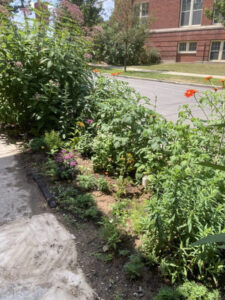
Spring Street Deli garden
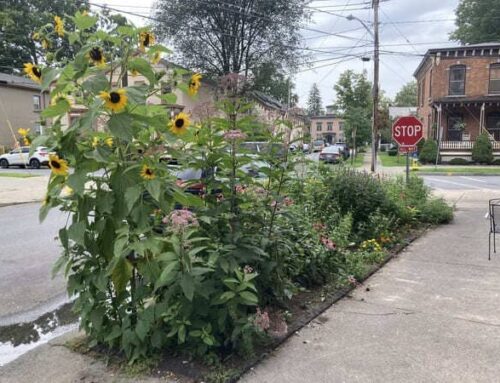
This garden is a “chaos garden”, that is, a largely unplanned collection of native species chosen for their ability to survive mild neglect and full sun while providing season-long blooms for pollinators to feed on. Originally, we planted tall species on the ends and lower species in the
middle, and had not done much replanting, other than removing unwanted volunteer plants and thinning the aggressive cutleaf coneflower to keep it from completely taking over the bed. Only
the ends of the garden survived the destruction of the sewer pipe repair. This year we added some native beebalm, black-eyed Susans, a mountain mint, some goldenrod and a number of annual marigolds, Mexican sunflowers and zinnias. A New England aster popped on its own. There is still some empty space in the middle – we will add more plants in the fall when conditions are favorable for transplanting perennials.
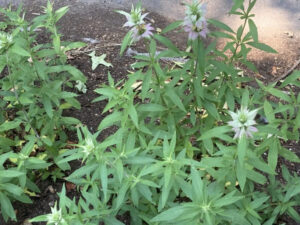
Spotted bee balm in the mid-Spring Street garden
We convinced a neighbor to let us plant our first new garden on their hellstrip just prior to launching this initiative publicly. Their hellstrip was mostly bare dirt, so we covered it with 25 bags of organic compost and then planted directly into it. We wanted the garden to be low at the ends since visibility is important for cars pulling out of driveways. We put spotted beebalm on one end and native geraniums and golden ragwort on the other end in the full shade of a tree. The other species planted, mostly in groups of three, include mountain mint, Joe Pye weed, blue lobelia, beardtongue foxglove, big leaf aster, foam flowers, evening primrose, aromatic aster, goldenrod, pink coreopsis, boneset and a single golden alexander that we had lying
around. Rabbit damage has been heavy on the coreopsis and asters and we are not sure they
will make it. Since the plants are still small, we are watering nearly every day and examining
which plants are most successful. So far the spotted bee balm is the star of this garden.
Existing Spring Street hellstrip garden
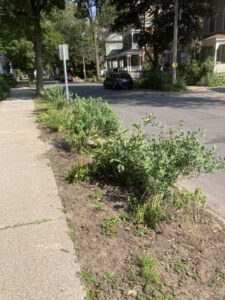
Existing Spring Street hellstrip garden
When the previous owner of this property passed away, her garden was left untended so we asked if we could weed it and add to it. It already had four healthy native false indigo plants, which are excellent for hellstrips because they thrive in poor soils, plus two peonies, some
astilbe and daylilies, and a couple of rather bedraggled native columbines that desperately needed water. We added six bee balm plants, three narrow-leaved mountain mints, three spotted beebalms and ten annual Mexican sunflowers. The sunflowers were promptly eaten by rabbits. We will add more perennials in the fall.
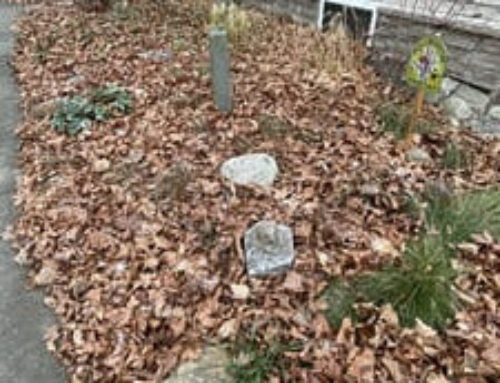
One of these gardens is on Spring Street and two are on Empire Avenue. All these gardens are under construction and will be planted in the fall. We laid down cardboard or newspaper on top of the grass of each hellstrip, then added a layer of compost on top of the paper. Depending on the size of the plant-able area, it takes 25 to 35 bags of compost to fully cover an average 25- foot hellstrip. We will let these gardens sit for the rest of the summer, watering if it doesn’t rain at least once a week, and then will plant into them in the fall, primarily with plants purchased from Home Earth Alliance. It is also fine to prep the hellstrip with cardboard and compost and let it sit all winter before planting in the spring. If you choose to plant in the spring, you can try winter sowing seeds, a very economical alternative to purchasing plants or plugs. More on that in a future post.
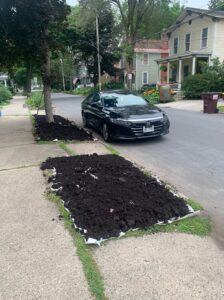
New hellstrip gardens
Be a hellstrip hero!
We hope you will consider planting a perennial pollinator garden on your hellstrip or elsewhere on your property. It is important to provide a variety of plants that bloom at different times, preferably local ecotypes but at least native to this region of the country. If you need help designing your garden or finding places to buy plants or compost, please feel free to reach out to us at pollinators@sustainablesaratoga.org. We would also like to hear from you if you have a pollinator garden – we love seeing what other people have done.
1 If you move any plant from an existing garden bed, make sure the bed does not have jumping worms in
it.